Tennis for everybody
Tennis Australia is rethinking how the sport is played and who gets to play it. Their All Abilities Tennis program is making a difference, reports Katherine Granich.
Tennis is more than a game, it’s a space to move, connect, and belong.” These words describe All Abilities, the inclusive program run by Tennis Australia – and they’re not just lip service. Tennis isn’t just a sport, it’s a community, and being part of a community is incredibly important for disabled people and their families.
Dr Danielle Gescheit, Head of Players with Disability and Program Optimisation at Tennis Australia, says that’s one of the reasons the All Abilities Tennis program is so impactful. “We love seeing kids and parents connect with a whole new community. Yes, it’s about tennis, but it’s also about building those vital connections that help everyone feel like they belong.”
At its heart, the All Abilities Tennis program is about making sure everyone, of every ability, can experience the fun, fitness, and connection the sport brings.
IN THE BEGINNING
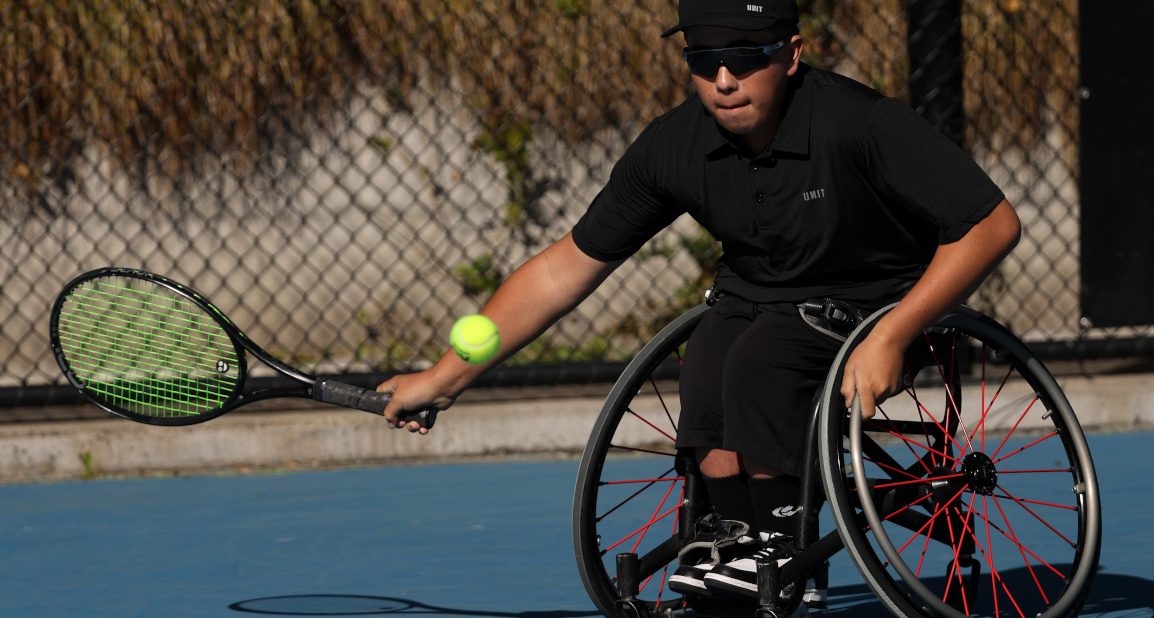
“Wheelchair tennis is where it started for us,” Danielle says. Turns out Australia is something of a world leader in wheelchair tennis. First developed in 1976, wheelchair tennis was demonstrated in the Seoul 1988 Summer Paralympics, and debuted in Australia soon after, where it quickly became popular. By 2000, the sport’s visibility increased significantly during the Sydney Paralympics, leading to its inclusion in all four Grand Slam tournaments – and at the 2002 Australian
Open, competitive wheelchair tennis took place at the same time and in the same venue at a Grand Slam for the first time.
Wheelchair tennis might be the most well-known form of inclusive tennis, and the most lucrative for professional players (the prize pool in 2024 for wheelchair events at the Australian Open exceeded $1 million). And it’s served as a springboard for the All Abilities program, which Tennis Australia launched in 2017.
Besides wheelchair tennis, All Abilities offers pathways for children and young people with a range of disabilities: Deaf and hard of hearing, intellectual disability and autism, blind and low vision, and the newest stream, para-standing tennis for players with short stature or limb difference.
Adaptations to play and to rules are tailored for the players’ level of classification – although core rules are similar, some formats use modified scoring, coaching support, or visual cues. For example, blind and low vision tennis players use special “audible” balls which are larger than regulation-sized tennis balls, and contain
a rattling or jingling device inside so that players can track it by hearing. They also use tactile court lines and have bounce
rules based on their classification. Deaf and hard of hearing players use the same rules as mainstream tennis, but use visual cues such as hand signals, gestures, and facial expressions, as well as inbuilt “pause points” in the game when sound isn’t perceived.
These are only some of the ways Tennis Australia has thoughtfully adapted the game to serve – pun intended – people from across the spectrum of disabilities. And they don’t stop here.
“Our programs go from entry level squad or group-based training, all the way through to international representation where our players represent Australia overseas,” Danielle explains. “Our goal is to offer the most opportunities to the most players with disability, across the board. It’s very comprehensive.”
OPENING DOORS, BREAKING BARRIERS
Despite its growth, the path hasn’t always been straightforward. Danielle acknowledges that “finding the front door” can be challenging at times. “We want to make it as easy as possible for people to get involved, so we’re working on overcoming some of the hurdles they might face.”
This means liaising with local clubs to ensure venues are suitable and accessible, and working with coaches and volunteers to ensure personnel are trained and confident. “Professional development is key, because some coaches might be keen to get involved but are a little apprehensive about what
it entails,” Danielle admits. “So we work hand-in-glove with coaches who are already successful in this space, and we hero those coaches who are doing great – to let them know we value them, and to offer upskilling when and where it’s appropriate.”

It’s a perception change – getting clubs to realise that offering inclusive tennis adds value. “To be able to say you’re an inclusive club, and that anyone who comes through the doors will be able to get on court and get playing, is immensely attractive to potential members and to the community,” Danielle says.
GETTING IT RIGHT FROM THE START
It’s important that disabled players, especially children, have a good first experience so they don’t feel discouraged. “We know that a shaky start can put families off sport,” Danielle says. “So we want children to feel welcome and included from the beginning, and we keep supporting them and their families as they move along the pathway.”
Danielle encourages families to begin online at the All Abilities page (tennis. com.au/play/inclusive-tennis/all-abilities), where you can find out more about each inclusive program and get in touch to be connected with a club and coach suited to your needs. Equipment support is also in place, including wheelchair loans, ensuring gear is not a barrier.
Tennis Australia also runs parent education sessions throughout the year.
“A recent one was for parents whose children were going overseas to compete for the first time,” Danielle recalls. “We know parents are nervous, so we held a session explaining how the trip will work, how the players will be supported, what parents can expect, how we’re going to communicate while the players are away.
“We want parents to know we’re on the journey with them. We’re on the same side. We’re here to support you, and to work collaboratively with you, so your child has the best experience with tennis.”
This emphasis on support is about much more than just getting on court. It’s about helping children and their families find a space where they feel safe, valued, and included.
MORE THAN JUST A SPORT
For many families, joining All Abilities tennis is about so much more than learning to play. Perhaps the most rewarding part for the team is watching the journey unfold – from tentative beginnings to fullfledged representation.
“We’ve seen kids start as five year-olds and end up representing Australia internationally. It’s incredible to see their journeys,” Danielle says. Ultimately, though, “The real win is seeing kids and families move from isolation to connection, where they’re suddenly part of something life-changing, and knowing we’ve helped open that door.”
To learn more about Tennis Australia’s All Abilities programs head to tennis.com.au/play/inclusive- tennis/all-abilities