Pathways to adventure & inclusion
We talk to Clayton McIntosh of Crocodile, Crocodile about how he’s bringing play and imagination to community spaces for every child whatever their ability.
Can you tell us about your business, Crocodile Crocodile, and what’s behind the playful name?
Crocodile Crocodile is my creative passion project where design meets inclusion. It’s my freelance design business focused on playful, imaginative work, often centred on kids and community spaces. I love creating practical, creative ideas that make things more inclusive and engaging. My work spans graphic design, illustration, video, and branding, with a growing interest in making public spaces more welcoming through simple, clever ideas rather than expensive upgrades.
The name comes from a playground game, similar to Red Rover, with the chant: “Crocodile Crocodile, can we cross the golden river? If not, why not? What’s your favourite colour?” It loosely explores inclusion – someone decides who can cross – and the questions mirror creativity and design. The repeated name also hints at two individuals, two crocodiles, each with different needs.
Your daughter’s experience sparked this whole journey. What does play look like for her – and what’s often missing in mainstream playgrounds?
I have three kids. My six-year-old daughter has Spinal Muscular Atrophy and uses a wheelchair. Most parks are inaccessible, covered in woodchips and filled with swings, climbing frames, and slides. Even “accessible” equipment often means lifting your child in for a very short play and rarely feels designed for kids with disabilities or their carers. Many accessible options feel more about playground companies’ profits than real inclusion. Meanwhile, my three-year-old loves climbing, and our baby is just starting to explore. Yet most parks remain dull and repetitive – swing, slide, wobbly bridge, tictac-toe. Has anyone ever played tic-tac-toe at a park for more than 30 seconds?
You came up with Playful Pathways as a response to inaccessible playgrounds. How did the footpath mural come about – and why imaginary play?
With parks often inaccessible or dull, we had to find other ways to play, like paths or picnic shelters. Imaginary play works brilliantly for kids of all abilities: it can be solo or in groups, is open-ended, and adapts to any situation. With creativity and storytelling, “playing house” or “playing shops” becomes magical worlds. But kids and adults often struggle to invent games – prompts help.
Talking with councils, teachers, therapists, and business owners, everyone agreed playgrounds aren’t ideal for kids in wheelchairs. Budgets are limited, and solutions are expensive. Small, low-cost ideas can go a long way.
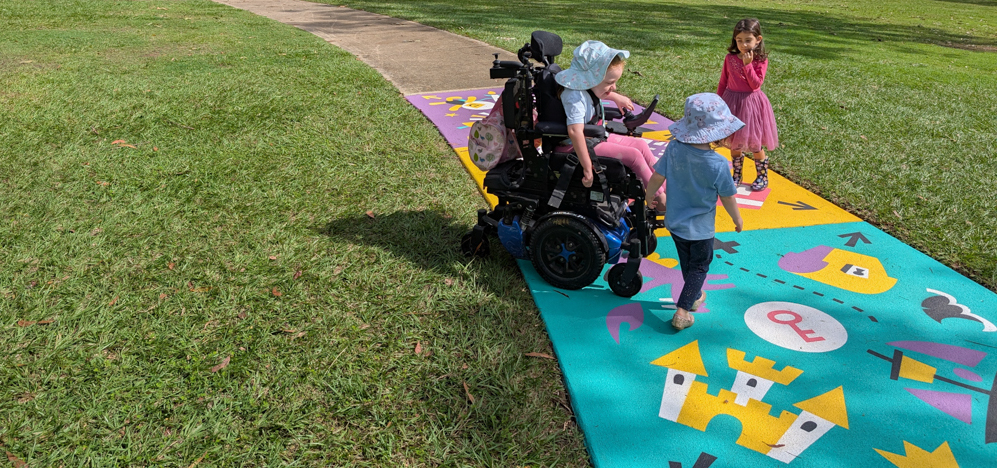
This led to Playful Pathways for All. Supported by Ipswich City Council and Arts Queensland, I designed a path section with simple illustrations and story prompts – castles, dragons, astronauts, detectives – open for anyone to explore, respond to, and play however they like. There are no instructions, and the project has been warmly received, even by those not using it for imaginary play.
How has your background as a designer – and the community around you – helped bring this vision to life?
I’ve worked in education design, from textbooks to magazines and comics, which taught me the value of play and designing for kids. Many projects focused on accessibility, and I’ve been influenced by Universal Design (UD) and Universal Design for Learning (UDL), which prioritise inclusion from the start. Playful Pathways is essentially a graphic design project in a public space, thinking about inclusion from day one.
The community has also been hugely influential. Many people are shocked by how inaccessible parks are. Hearing carers’ and disabled people’s experiences helps me see different perspectives. For example, after sharing my observations on Instagram, parents asked me to advocate for fenced playgrounds, something I hadn’t encountered before. Everyone agrees, too many playgrounds aren’t serving their communities.

What else did it take to make this project a reality?
Making Playful Pathways happen has taken patience and persistence. I was warned early on that projects like this often take longer than expected and may not be possible in public spaces. It took a couple of years to get off the ground.
Practical challenges included approvals from multiple council departments and addressing safety and legal considerations. Support from staff who believed in the project made a huge difference. Building connections and getting others to see the value of inclusive play was essential. I’ve learned that the design is just a small part of these projects. I have other similar projects underway, but like this one, they’ll take time to come to life.
What’s next for Crocodile Crocodile? What’s the dream?
Next is growing the business and bringing more creative projects to life. I take on playful design work – graphic design, murals, illustrations, videos, campaigns, and brand projects – all with inclusion and imagination at the heart.
I’m keen to collaborate with councils, schools, and other organisations on simple creative ideas for inclusive public spaces. I’m also continuing advocacy for children with disabilities, creating video content, and releasing fun t-shirts with messages of inclusion.
The dream is to grow Crocodile Crocodile into a thriving design company known for creativity and inclusion, designing low-tech, high-impact playgrounds for the whole community. Based in South East Queensland, I’m also excited to contribute to inclusive projects leading up to the Olympic and Paralympic Games.
If any of this resonates, visit crocodilecrocodile.com.au or follow @crocodile_crocodile_au.