Built for her
ADVERTORIAL
For Rachel, the right wheelchair isn’t just about mobility, it gives her access to the world, explains Katherine Granich.
When Heather first became a mother, she never imagined the road ahead would be quite as complex as it turned out to be. Her daughter Rachel, now 31, was born with neurofibromatosis and cerebral palsy, and has lived with the layered realities those diagnoses bring – hip dysplasia, a PEG tube, autism, an intellectual disability, and a body that simply does not work the same as others.
Rachel is nonverbal, uses a wheelchair, and has needed specialist equipment her entire life. She lives in supported accommodation, where a team of carers knows her well. She is also, by her mother’s account, a person of real presence: Curious, engaging, and attuned to the people around her.
“She’s always interested in people,” Heather says. “If you give her attention, she’ll make eye contact with you, and she’s quite engaging in her own way.”
For families navigating this kind of complexity, the question of equipment is never a small one. A wheelchair is not just a mobility device. A standing frame is not just a piece of apparatus. These are the tools that give a person access to the world, and when they are fitted well and built with genuine understanding of who is using them, the difference is profound.
Heather first turned to Dejay when Rachel’s previous wheelchair – an imported model – became a problem. Parts were difficult to source, and when Rachel’s physiotherapist Alfred began looking for a provider who could do better, Dejay came highly recommended. What followed was a relationship built on something Heather had not always experienced: The sense that someone was actually listening.
Alfred’s assessment of Dejay was straightforward. “He told me that these are people who would build what Rachel needs from scratch,” Heather recalls. And that is exactly what the Dejay team did.
Rachel’s needs are specific and, in some ways, quite particular to her. She tends to bounce as a form of self-regulation. Her first custom-built Dejay Smik wheelchair was designed with a back that could lock for transport, but also flex when she needed it to, accommodating her natural movement rather than fighting against it. Other customised features, such as footplates and a special cushion to protect her skin from pressure sores, were also included.
This all grew out of thoughtful conversations between Dejay equipment consultant Lena and Rachel’s physiotherapist, carers, and her mum, Heather.
Heather values Lena’s responsive approach. She describes Dejay as a provider that genuinely asks what is needed and then builds to meet it, which matters enormously when the person using the equipment cannot speak for herself. Rachel cannot say that she is uncomfortable, or that a fitting is not quite right. The people around her have to speak for her, and the people building her equipment have to take that seriously. In Heather’s experience, Dejay does exactly that. Rachel has recently received another updated Smik wheelchair, and each iteration has been an improvement on the last.

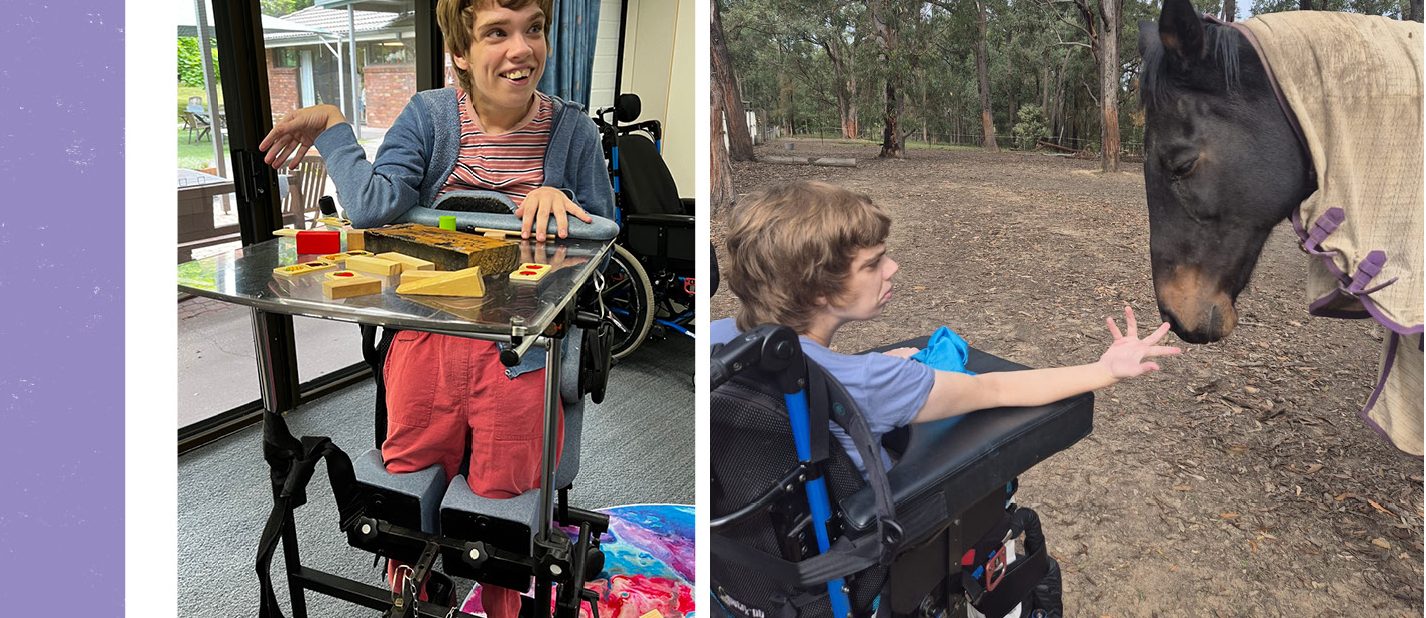
Rachel also uses an Evolv standing frame from Dejay. Weight-bearing is important for her physical health, and while it is not her favourite activity, she tolerates it well – especially, Heather laughs, when there is eating involved.
But as much as the equipment itself has made a difference, Heather is equally clear about what she values in the people behind it. When Michael, who works in Dejay’s fabrication and workshop department, came to deliver Rachel’s most recent chair in person, Heather was struck by the way he handled himself. He did not speak past Rachel – he greeted her directly and took the time to engage with her. Lena, who visits regularly for adjustments and check-ins, brings the same quality to her work.
“They say hello to Rachel,” Heather says. “They show her that respect.”
It might seem like a small thing. But for families who have spent years watching their loved ones be looked through rather than looked at, it is not small at all.
Heather is direct about what the equipment means in practical terms. Without her wheelchair, Rachel would not be able to attend her day programme. She would not be able to get out into the community. She can move around independently to some degree, but the chair is what connects her to the wider world.
“It’s about giving people dignity,” Heather says. “People who need wheelchairs or need equipment – it gives them the ability to live their fullest life.”
That phrase, living your fullest life, is one Heather returns to more than once, and it clear she values that deeply. Rachel goes to a day programme. She attends equine therapy, where she and the horses simply get each other. She celebrated her milestone 30th birthday with people who love her. She lives, in every real sense of the word.
None of that happens without the right support, the right equipment, and the right people building it with care. For Heather, Dejay has been part of that foundation – a provider that does not just supply a product, but takes the time to understand the person who will use it. As Heather puts it, that understanding, that willingness to listen and to build accordingly, is what makes the difference between equipment that works and equipment that truly fits.