Alex’s story: playing today, preparing for tomorrow
ADVERTORIAL
When Marian Graham first heard about LusioMATE from another Brisbane family, she was hopeful. Her five-year-old son Alex had always thrived in face-to-face therapy but struggled with home routines. She wanted something different, something that could give him motivation, structure, and a sense of ownership over his therapy at home. With school on the horizon in 2026, the timing could not have been better.
“Our goal is to prepare Alex for school, and LusioMATE is helping us get there, not just with engaging content, but with real progress we can see and measure,” Marian says.
FINDING SUPPORT IN COMMUNITY
The journey began with a recommendation from another parent. Marian decided to try LusioMATE and quickly introduced it to Alex’s physiotherapist, Christine Jessop. Christine immediately recognised the potential and has since referred more than ten clients to the platform.
Occupational therapist Danielle Strickland from Everton Therapy also became involved, forming a collaborative support team working across disciplines to support Alex’s therapy at home and in preparation for school.
FROM RESISTANCE TO ROUTINE
Before LusioMATE, Marian faced daily resistance when trying to do therapy at home with Alex. Therapy was something he associated with clinicians, not home, which he viewed as a space to relax. That distinction made consistency difficult.
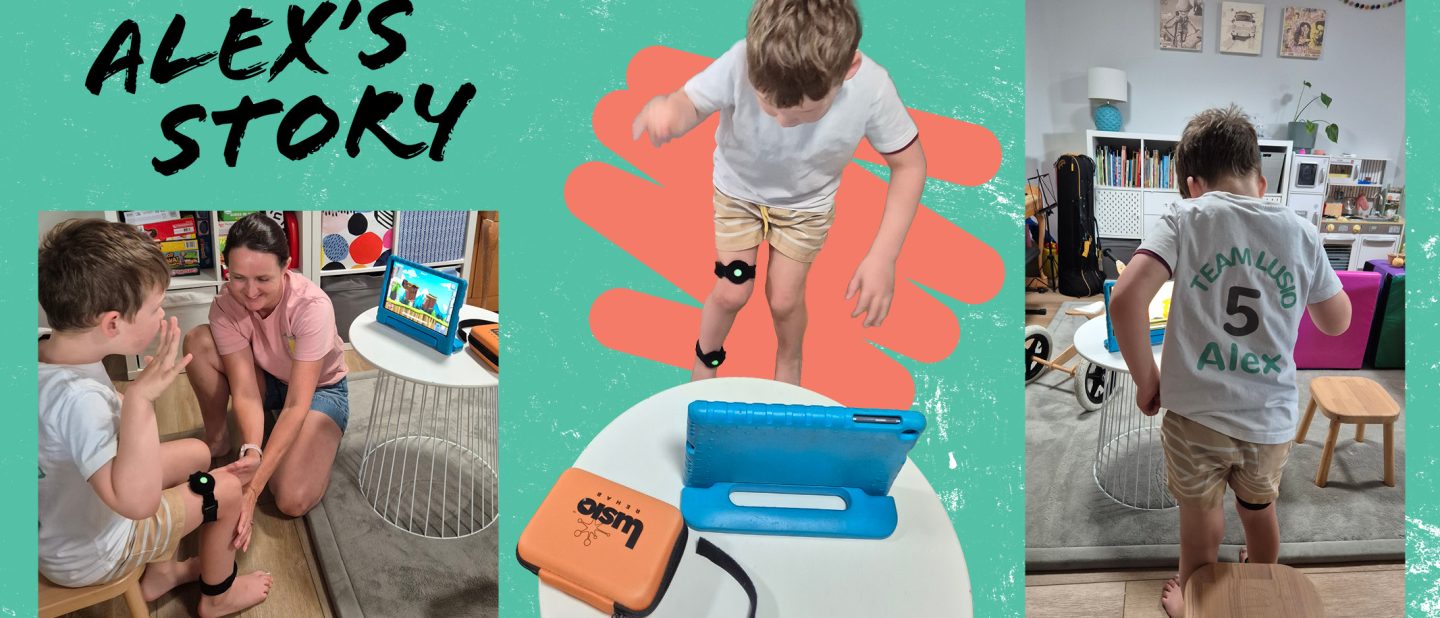
“The LusioMATE has given him more choice and control over what he is doing, while making it a fun activity at the same time,” Marian shares. “Alex now does therapy at home and is proud to achieve his goals.”
She recalls a breakthrough moment when Alex proudly demonstrated the interactive activities to his older brothers. “Having pride in completing goals, and being able to show his big brothers how to play, has really given him more motivation,” she says.
For Marian, LusioMATE has been more than a therapy tool. It has increased her confidence as a parent supporting daily therapy. “I feel more confident now that I can keep on top of his daily therapy needs without his therapists being there,” she explains. “His therapists can add in goals and exercises, and I can follow them through. I feel much more confident that I can stay on top of it now.”
Receiving a Team Lusio t-shirt marked another milestone. “He felt so proud,” Marian says. “With two older brothers who play sports and have their own team shirts, Alex was thrilled to have something of his own.”
PHYSIOTHERAPY PERSPECTIVE:
Targeted Practice with Measurable Feedback
For Christine Jessop, LusioMATE stood out from the beginning because of its ability to provide objective feedback on specific movements through wearable sensors.
“It offered feedback of selected movements via sensors,” Christine explains. “Targeted movements for a particular functional goal are rewarded through activities on a tablet, phone or television that look motivating for children.”
From a physiotherapy perspective, repetition is critical for strengthening and the development of neural pathways.
MAINTAINING ENGAGEMENT IS OFTEN THE BIGGEST CHALLENGE
“Maintaining engagement to keep practising a movement allows for the repetitions required for neural pathways and strengthening,” Christine says. “It also offered a way targeted movements could be practised outside of the clinic, at home, with feedback ensuring the correct movement is being practised.”
Within Alex’s program, Christine selects specific movements for home practice. Those movements are then incorporated into functional activities during clinic sessions.

“Knowing Alex practises targeted movements at home allows extra time in clinic sessions to focus on functional training, so therapy sessions are more efficient,” she explains. “Improvements in functional goals reflect improvements at an impairment level through home-based practice of selected movements using LusioMATE as part of his home program.”
Christine notes that while it is difficult to attribute progress to a single intervention, increased repetition of targeted movements is likely contributing to gains in isolated movement, strength and range of movement.
In comparison to traditional home programs, LusioMATE provides real-time feedback about the quality of movement and the number of correct repetitions completed. It also allows for objective progression in terms of range of movement, graded gravity positions and repetition targets.
“It provides a more objective approach to monitoring and progressing activities,” Christine says. “It gives a more accurate picture of how many repetitions are being done outside of clinic sessions, which impacts support planning and allows more clinic time to be focused on functional training.”
Parents have also reported practical benefits. While younger children still require help to set up, the system reduces the need for constant hands-on assistance, allowing parents to supervise from a distance while managing other responsibilities.
OCCUPATIONAL THERAPY IN ACTION
From an occupational therapy perspective, Danielle Strickland is excited by how LusioMATE shifts therapy from being adult-led to child-driven while still supporting motor development.
“Children initiate, engage with, and persist in activities more independently, fostering confidence and self-motivation,” she explains. “At the same time, the repeated, purposeful movement supports motor skills such as postural control, coordination and motor planning. These experiences directly support school-readiness skills including task initiation, sustained engagement and participation in routines.”
With Alex, Danielle targets goals such as bilateral coordination, midline crossing, upper limb strength, motor planning, sustained attention and endurance. LusioMATE enables joint-specific movements to be practised repeatedly within motivating activities, encouraging symmetrical use of the body and controlled movement.
Danielle and Christine coordinate their approaches using LusioMATE as a shared reference point. “We each address our discipline-specific goals while working towards shared functional outcomes,” Danielle says. “It helps align therapy approaches, reinforce consistency and reduce duplication across services.”
She also highlights the importance of generalisation. The same activities can be used at home, in therapy or in educational settings, supporting the transfer of skills into classroom routines, peer play and daily self-care tasks.
For other occupational therapists considering the platform, Danielle points to its versatility, measurable feedback and capacity to support independence. “It supports autonomy, confidence and self-initiation,” she says. “It allows therapy to remain goal-directed while feeling natural and functional.”
Looking Ahead
Alex is not just doing therapy. He is taking ownership of it. With the support of his clinical team and a platform that adapts alongside his progress, he is building the strength, confidence and consistency needed for school and beyond.
“It is not just about fun,” Marian says. “It is about functional outcomes and long-term independence. LusioMATE has helped us create a routine that feels empowering and effective.”
As Alex prepares for the transition to school, his therapy is no longer confined to the clinic. It is embedded into daily life, supported by measurable feedback, interdisciplinary collaboration and a child who is proud of his progress.
Contact Lusio Rehab for more information today and learn how they can support your child’s therapy journey.