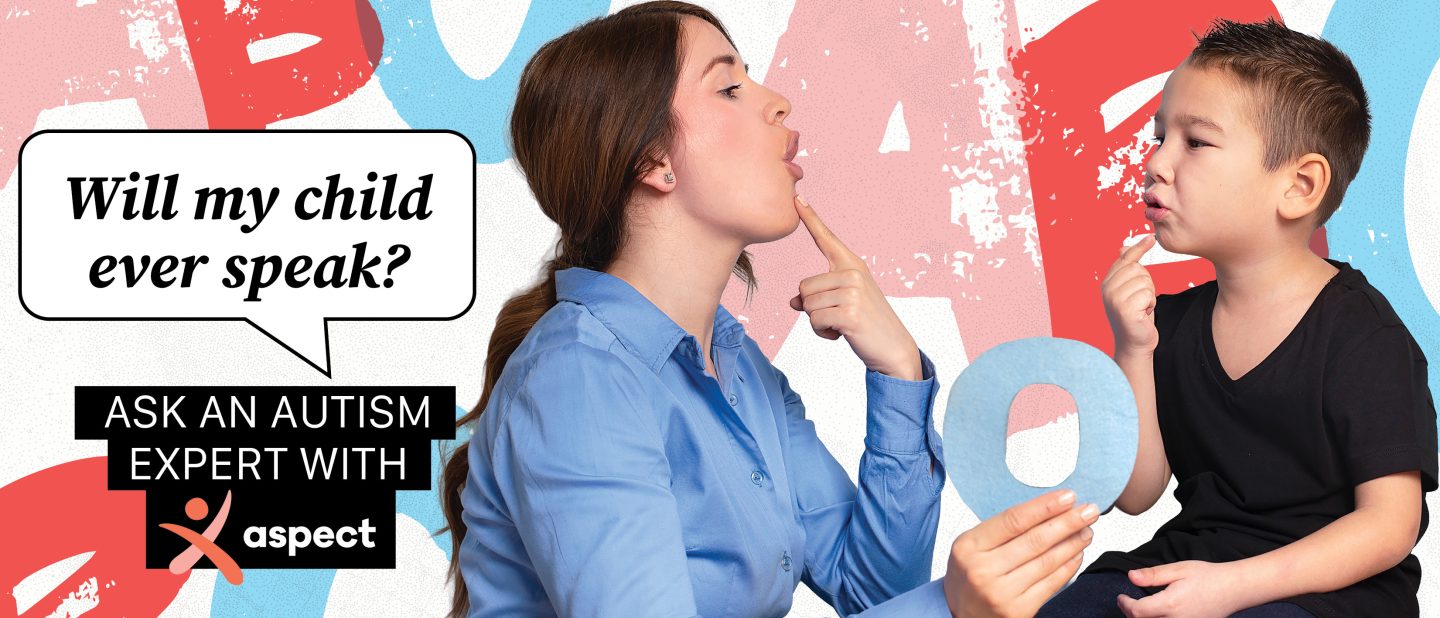
Ask an autism expert: will my child ever speak?
by Jessica Mennetrier, Speech Pathologist Practice Leader, Supervisor and Clinician at Aspect
Question: “I’m worried my child isn’t talking yet.”

My son isn’t saying any words yet. He makes sounds and sometimes grunts or cries, especially when he wants something, but I can tell he’s trying to communicate with me and getting frustrated when I don’t understand.

Simple things like mealtimes can turn into meltdowns because I feel like I’m guessing and getting it wrong. I try to talk to him and read books together, but I’m not sure if I’m doing the right things.

What can I do to help him?
Response:
It sounds like you’re really tuned in to your son and the ways he’s already trying to communicate with you. That’s such an important foundation. Every Autistic person is unique and so too are their communication styles, skills and preferences.
I encourage parents to try to think or ask “How IS my child communicating? How can I join in, support and experience together, through this?”
At Aspect, we focus on a Total Communication Approach, using a range of modalities and techniques to encourage, develop, assist and ultimately thrive with their communication. With this mindset, parents can explore and discover the best possible ways of communicating and building on language with their child.
Right now, your son is showing you that he wants to communicate, and that’s something you can build on to try and better understand what he’s needing. For example, when he makes a sound or reaches for something, you can model simple language alongside it: “You want water,” or “water” or “Up, please.” It also helps to talk out loud about what your child is doing and/or interested in: “You are jumping”, “Jumping, jumping”. Furthermore, when your child is showing interest in something, talk about it; “Look, Butterfly!” “Oh a car!”. This helps him make connections between his actions and environment, your words, and the outcome.
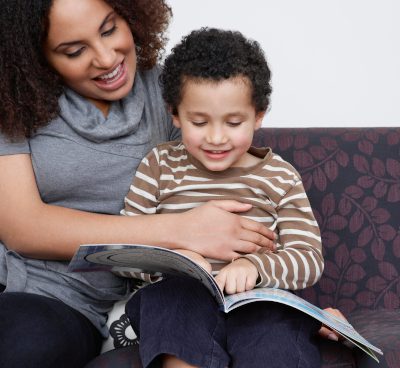
It can also help to introduce other ways for him to express himself, such as gestures, pointing, or even simple visuals like pictures of favourite foods, people or toys. These supports don’t stop children from learning to talk, in fact, they often reduce frustration and support language development.
It’s really lovely that you’re already sharing books together, that’s such a rich opportunity for connection and language, especially if your child enjoys it. Alongside reading the story, some families also find it helpful to simply talk about what they notice in the pictures. For example, you might comment, “I can see a blue bird,” or “The blue bird is eating.” Focusing on noticing, commenting and keeping questions to a minimum, can take the pressure off and allow you to model lots of different words and short sentences in a relaxed and fun way.
I can never say with certainty that nonspeaking Autistic children will talk – there’s really no way to predict speech development or use. I can however say that for some it takes a little bit more time to get there. A nonspeaking Autistic child, over time, might speak, and use speech or use Augmented and Alternative Communication (AAC), or sign or gestures, writing, drawing or all the above, to communicate.
Most importantly, you don’t have to navigate this on your own. A speech pathologist can work with you to understand your son’s unique communication intents, and give you practical, tailored strategies to use at home, so you can meet him where he is at and grow with him from there.
What does nonverbal, nonspeaking, and preverbal actually mean?
“Nonverbal” and “nonspeaking” are terms we hear used to describe people who do not use spoken language to communicate.
Nonverbal can come with the connotation of not having any functional use of language however communication occurs in multiple ways and spoken language is just one of these.

Nonspeaking is used for people who use other means to communicate and reflects the lived experience of many Autistic people. It is also helpful to refer to how the person IS communicating, as opposed to what they are not using. For example, they use AAC and gestures with some vocalisations to communicate.
Preverbal is used when a child is still developing speech.
Communication is a right for all children. We want the child to be able to express themselves, ask for what they want and need, and become as independent as they can. All of this is possible.
Additional resources
Here is some additional information you can check out too:
- Positive Partnerships – Communication and autism webinar – https://www.positivepartnerships.com.au/resources/practical-tools-information-sheets/communication-and-autism
- Speech Pathology Australia – Communication milestones – https://www.speechpathologyaustralia.org.au/Public/Public/Comm-swallow/Speech-development/Communication-milestones.aspx
- Raising Children Network – Language development for children – https://raisingchildren.net.au/babies/development/language-development/language-development-0-8
- Aspect podcast – Communicating with nonspeaking Autistic children – https://a-different-brilliant.captivate.fm/episode/communicating-with-non-verbal-autistic-people/
- Aspect early childhood webinar with therapist – Supporting Early Language Development and Visual Supports – https://shop.aspect.org.au/products/supporting-early-language-development-and-visual-supports-early-childhood-webinar-series-0-6-years
About Jessica, Aspect Therapist
Jessica Mennetrier is the Speech Pathologist Practice Leader, Supervisor and Clinician at Aspect. With more than 17+ years of experience, she currently works with Autistic individuals in the Illawarra region of NSW.
About Aspect
Aspect (Autism Spectrum Australia) is one of Australia’s largest autism-specific service providers, with one of the world’s most extensive autism-specific educational programs. Celebrating 60 years in 2026, Aspect is a not-for-profit organisation working in partnership with people of all ages on the autism spectrum to co-develop, co-produce and co-deliver supports and services that are individualised, goal driven and grounded in evidence-based practices.