Clown doctors: the most serious kind of silly
In the long and largely joyless genre of Things That Happen in Hospitals, the arrival of a Clown Doctor is — statistically, emotionally, and by almost any other measure – one of the better ones.
If you’ve ever spent any time in hospital with a child, you’ll know that hospitals operate in a completely different time zone to the rest of the world.
Outside, people are arguing about school lunches, forgetting library books and wondering what’s for dinner.
Inside, you’re measuring time in test results, appointments, ward rounds and whether your child has managed to eat three bites of toast.
For many disability families, hospitals aren’t a one-off experience. They’re woven into the fabric of family life. Some children have appointments every few months. Others spend weeks, months or years moving through a revolving door of specialists, therapies, procedures and admissions.
You become weirdly familiar with hospital parking. You know where the decent coffee is. You develop strong opinions about waiting rooms. And you become acutely aware of how exhausting it can be for a child to always be the patient.
That’s why the idea of Clown Doctors is so fascinating. Because on paper, it sounds slightly ridiculous.
A clown? In a hospital? Really? Yet the more you learn about the program, the more sense it makes.
So what’s actually going on when that white coat and red nose walks through the door?
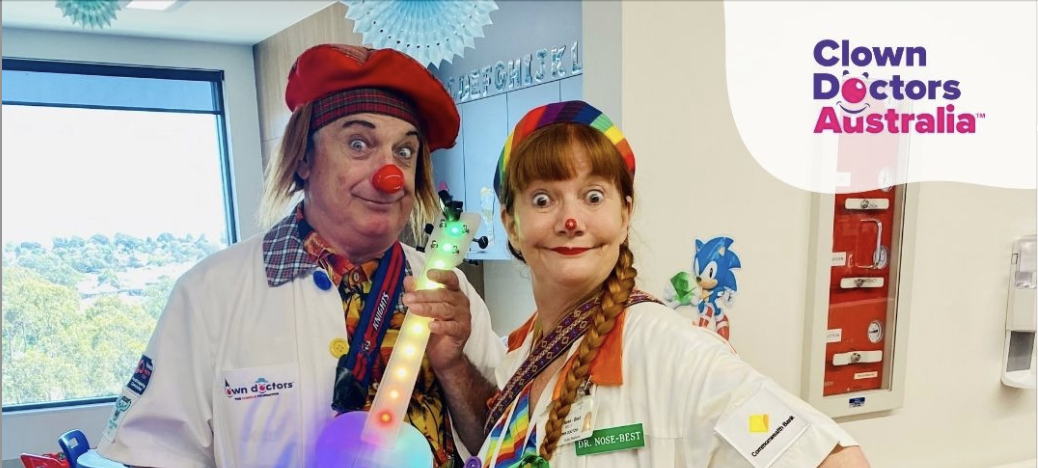
Clown Doctors aren’t volunteers in costumes. They’re professional performers with specialist training in working alongside healthcare teams. They understand clinical environments, know how to read a room, and are there to support care, not interrupt it.
The key thing – the thing that distinguishes them from well-meaning chaos – is the approach. They seek permission, build rapport, and meet each young person exactly where they are. The humour is affirming; they laugh with, never at. They are, in short, doing something that looks effortless and is anything but.
Children and young people can even swap roles, becoming the doctor themselves through medical play – which, for a young person accustomed to being the patient, and the one being assessed, is not a small thing.
And for parents wondering whether their child is too old to benefit – the research suggests probably not. A study at an adolescent inpatient psychiatric unit in Victoria found that 95% of teenagers aged 13 to 18 reported having fun during Clown Doctor visits, with 96% of clinical staff believing the visits were beneficial. Turns out silliness doesn’t have an age limit.
The science, briefly
There is, it turns out, a growing body of research on laughter that makes it sound considerably less frivolous than its reputation suggests. Studies have shown that humour lowers blood pressure, releases endorphins, improves circulation, stimulates the nervous system, and strengthens immune function.
More practically: in every single case reviewed in one Australian study, paediatricians reported that Clown Doctors increased children’s willingness to cooperate with their medical assessment. Which is – if you’ve ever tried to get a resistant young person through a blood draw – not nothing.
One parent, whose words appear on the Clown Doctors Australia website, put it in terms that will resonate: “My daughter’s experience with the Clown Doctors has transformed her entire healthcare journey and consequently our stress and health as a family.”
The practical part
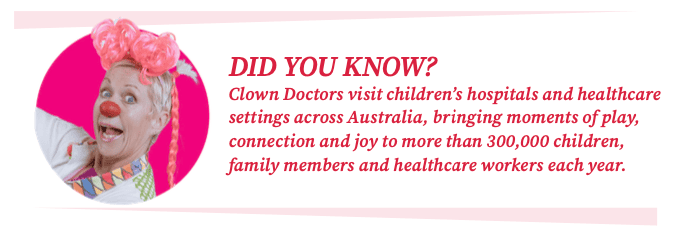
Clown Doctors currently work across 22 hospitals and two hospices in Australia, and the program has expanded to include one disability hub. The whole enterprise runs on donations – no government funding, no hospital budget – which means it exists because people decide it should.

If you’d like to know whether your hospital is on the list, the Clown Doctors Australia website has the details. And if
they do appear at your young person’s bedside: they will always ask first, always adapt to the mood in the room, and always – gracefully, professionally – make themselves scarce if it’s not the right moment.
Which, when you think about it, is a skill many of us are still working on.
5 Things You Might Not Know About Clown Doctors
1. They aren’t volunteers
Clown Doctors are professional performers with specialised training. Many come from backgrounds in theatre, music, improvisation and physical comedy, and receive additional training to work safely and effectively in hospital environments.
2. They work alongside medical staff
Clown Doctors aren’t there to distract from healthcare. They’re part of the broader care experience, often working with doctors, nurses and allied health teams to help reduce anxiety and make procedures less overwhelming for children.
3. Every interaction is different
Some children love big laughs and silly songs. Others prefer a quiet joke, a puppet, or simply someone sitting beside them. Clown Doctors tailor their approach to each child, always taking their cues from the child and family.
4. They’re backed by research
Studies from around the world have found that hospital clown programs can help reduce anxiety and distress in children before medical procedures and during hospital stays. Researchers have also noted benefits for parents and healthcare staff.
5. They don’t just help children
Parents, siblings and hospital staff often find themselves caught up in the fun too. A moment of laughter can break the tension in a room, offering a brief but welcome reset during what may be a very difficult day.
—-
Find out more at clowndoctorsaustralia.org.au