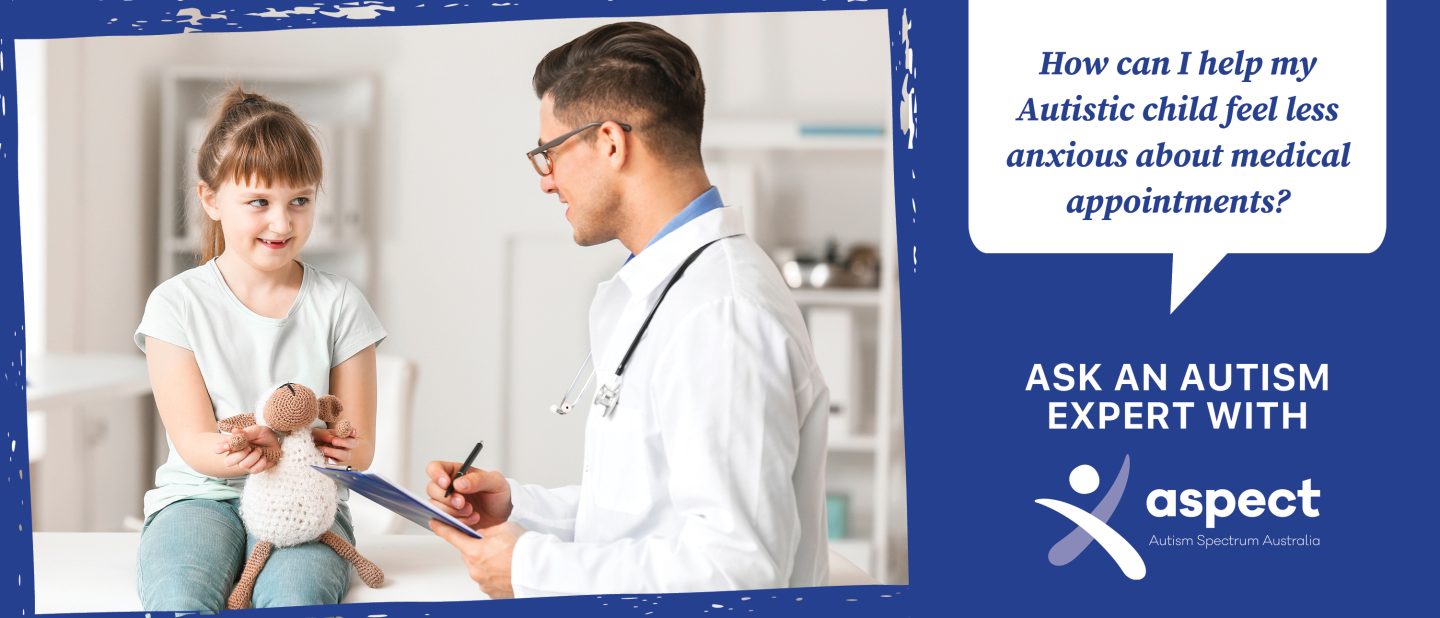
How can I help my Autistic child with medical appointments
by Mara Print, Occupational Therapist and Occupational Therapy Practice Leader at Aspect Therapy
Question: “How can I help my Autistic child feel less anxious about medical appointments?”

My 8-year-old daughter becomes very anxious whenever she needs to see a medical professional. She starts worrying days beforehand and sometimes refuses to get in the car. Once we're there, the bright lights, waiting room and unfamiliar equipment can quickly become overwhelming.

I know these appointments are important, but I hate seeing her so distressed. Is there anything I can do before the appointment to help make the experience less stressful?
Response:
Many parents tell us that medical appointments can be a challenging experience for their child. Whether it’s visiting the GP, dentist or optometrist, there are often unfamiliar people, bright lights, new equipment, different smells and noises, and unexpected sensations to navigate. For an Autistic child, that uncertainty can feel overwhelming and distressing.
The good news is that preparing your child for the appointment, helping them know what to expect and what they can do to feel calm during the appointment can make a big difference. Rather than focusing on simply “getting through” the appointment, think about how you can help your child feel safe, informed and supported.
Preparation starts before you leave home
As an Occupational Therapist, I encourage parents to prepare and make the doctor’s visit as predictable as possible.
To start with, when you make the appointment, let the practice know your child is Autistic and share anything that will help them have a positive experience. For example, does your child need communication supports or extra processing time? Are they sensitive to bright lights or loud noises? Would they benefit from a quieter appointment time or a longer appointment? Can you bring sensory supports with you such as headphones, sunglasses, or calming tools (like fidget toys or a weighted toy to hold)? Can you bring a favourite toy or a screen to provide a distraction?
Also, ask what supports the practice already offers. Increasingly GP offices are looking at ways to support not only neurodivergent patients, but staff too. Some medical centres or practices can provide photos of the clinician or the room beforehand, allow you to wait outside instead of in the waiting room, or explain exactly what will happen during the visit. Many practices are also looking at ways to make their clinic more sensory friendly, by adjusting the lighting, noise levels and making the environment as calm as possible. These small adjustments may make a big difference.
Create a visual story
One of the most helpful preparation tools is a visual story. This is a simple story using photos, pictures or drawings that walks your child through each step of the visit.
For example, your story might include leaving home, travelling to the clinic, sitting in the waiting room, meeting the doctor, dentist or optometrist, having the examination, asking questions, finishing the appointment and then doing something enjoyable afterwards.
When going through the visual story, use clear, simple language to explain what will happen. Try describing the appointment step-by-step so your child knows what to expect, and what they can do if they feel worried or overwhelmed.
If possible, include real photos of the clinic or healthcare professional, as these can make the experience even more predictable.
Watching videos or TV shows about visiting the doctor, dentist or optometrist can also be a helpful way to prepare for the appointment.
Think about your child’s sensory needs
Every Autistic child experiences the world differently, so consider what sensory experiences at the appointment might be overwhelming for them, and what sensory supports help your child feel calm and regulated. They may benefit from wearing noise-cancelling headphones while waiting, bringing a favourite fidget or comfort item, wearing sunglasses if bright lights are uncomfortable, or being able to move around before or during the appointment.
While the appointment is underway, encourage the healthcare professional to explain each step before they do it, to give your child time to process information and to ask your child if it is ok for them to proceed. If your child becomes overwhelmed or anxious, it’s okay to ask for a short break to use a calming strategy or to come back and complete the rest of the examination another day. Depending on the type of medical appointment required, telehealth appointments might be an option too.
Afterwards, have a positive experience to transition to and celebrate what went well. Focusing on your child’s successes, no matter how small they may seem, helps build confidence for future appointments.
Remember, every positive experience helps your child learn that healthcare appointments can be safe, predictable and supportive. By preparing together, working with the healthcare team and making small adjustments along the way, you can help reduce anxiety and build confidence one appointment at a time.

Additional resources:
Navigating healthcare – https://www.autismaustralia.org.au/blog/navigating-healthcare-systems
Raising Children Network – Taking your Autistic child to the doctor and other appointments – https://raisingchildren.net.au/autism/behaviour/common-concerns/appointments-asd
Aspect research about the experiences of Autistic people and eyecare – https://www.aspect.org.au/our-research/latest-research/eye-care
Information for families assisting Autistic care for their teeth – https://www.autismtoothcare.com/
Dental care for neurodivergent children – https://sourcekids.com.au/dental-care-for-neurodivergent-children/
Social Story about going to the dentist – https://www.youtube.com/watch?v=tLFNfumdFSo
NSW Health and Westmead Children’s Hospital visuals: I am going to see the doctor – https://aci.health.nsw.gov.au/__data/assets/pdf_file/0018/313380/NSW-Health-SLSM-Going-see-doctor.pdf
NSW Health and Westmead Children’s Hospital visuals: taking blood or putting in a cannula – https://aci.health.nsw.gov.au/__data/assets/pdf_file/0008/313379/NSW-Health-SLSM-Visuals-taking-blood-putting-canula.pdf
Using and creating visual stories – https://www.ambitiousaboutautism.org.uk/understanding-autism/health-and-wellbeing/support-for-education/visual-stories

About Mara Print
Mara Print is an Occupational Therapist and the Occupational Therapy Practice Leader for Aspect Therapy. Mara has supported Autistic children and their families for more than 20 years, across Sydney and the Illawarra region. Mara takes a neuro-affirming, strengths-based approach to supporting Autistic children and their families, focusing on supporting participation and building the capacity of families to best understand their child.
About Aspect

Aspect (Autism Spectrum Australia) is one of Australia’s largest autism-specific service providers, with one of the world’s most extensive autism-specific educational programs. Celebrating 60 years in 2026, Aspect is a not-for-profit organisation working in partnership with people of all ages on the autism spectrum to co-develop, co-produce and co-deliver supports and services that are individualised, goal driven and grounded in evidence-based practices.