Tubie life: a parent’s perspective
It might feel like it at first, but tube feeding is not the worst-case scenario. There are good points, too, says Katherine Granich.
For many parents, being told your child needs to be fed via tube can feel like a shock, and like failure. A feeding tube is a visible signal that something isn’t working quite right, and that medical intervention is now “in charge” of one of the biggest parts of life: Eating.
It’s no wonder that tube feeding is such an emotionally charged topic. Feeding is one of the first skills babies learn. And eating is a huge part of our everyday lives, as we plan our days around meals, share birthday cake, chat over a cuppa… Food is a source of joy and comfort, a reason to gather together, and there are many life milestones and rituals attached to food.
And when that part of life is restricted or significantly changed because tube feeding is necessary, parents (and children) can feel very disappointed, frustrated, and let down. It’s okay if you feel sad or upset, or you are grieving what you thought feeding your child would look like.
TUBIE OR NOT TO BE
My daughter’s tube-feeding journey started when she was two weeks old, and she’s gone through just about every kind of tube feeding there is. When it came to enteral feeding – that’s the medical term for tube-feeding the gastrointestinal tract – she started with a nasogastric tube (NG-tube), then progressed through (in no particular order) nasoduedenal (ND-tube), nasojejunal (NJ-tube), gastrostomy (G-tube), jejunostomy (J-tube), and gastrostomy-jejunostomy (GJ-tube). She also had a short stint on parenteral nutrition – intravenous feeding, which can be partial (PPN) or total (TPN), which for my daughter meant feeding via a central line.
When it came to enteral feeding, her feeding tubes went to various places, depending on her needs at the time – sometimes directly to her stomach, sometimes to her duodenum (the first part of the small intestine, just past the stomach), sometimes to her jejunum (the second part of the small intestine). She sometimes had several different kinds of feeding tubes at once, inserted and taped to various parts of her body.
In those early days, tube feeding felt intimidating and sometimes overwhelming. My daughter’s skin got irritated from the tape, so we spent a lot of time trialling different methods of securing her tubes. She loved to grab and pull on them – sometimes yanking them out! – so we also spent a lot of time back and forth to hospital getting tubes reinserted. (Some parents learn to successfully reinsert their children’s feeding tubes at home, but my daughter’s medical condition meant we needed to visit hospital every time a tube came out, so we had a go-bag packed and by the front door at all times!)
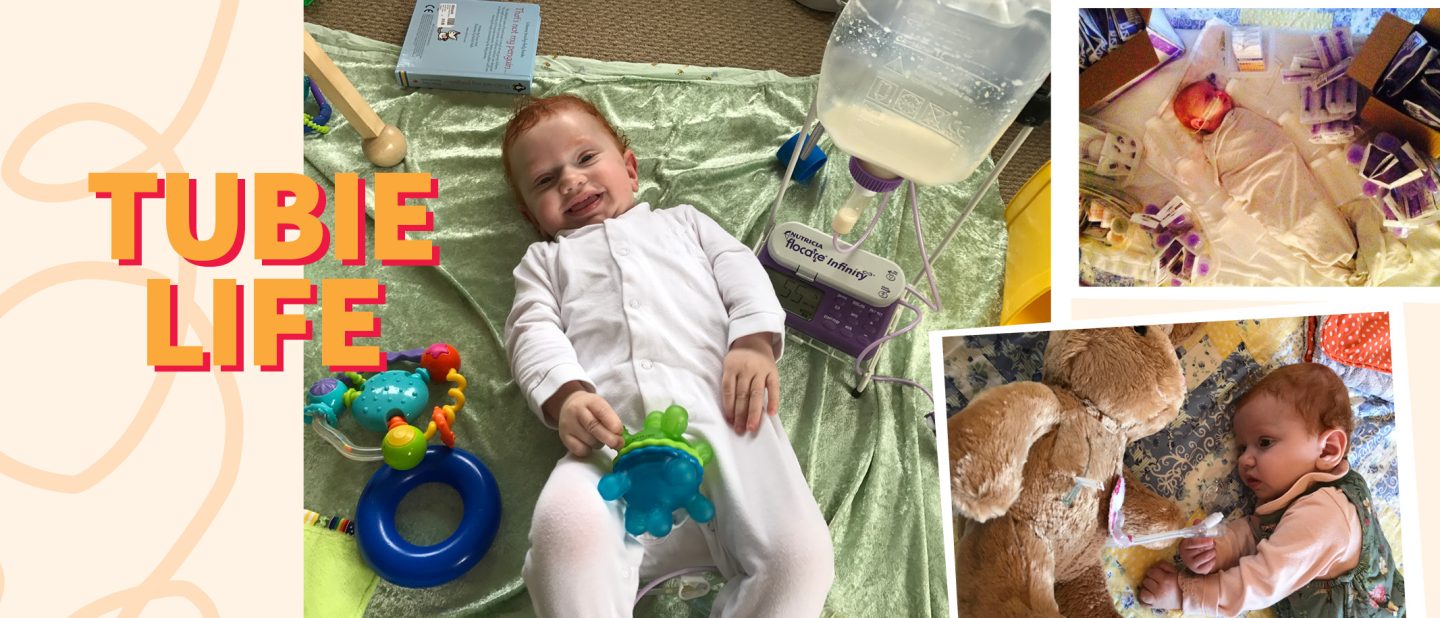
Some of my daughter’s tube feeds were done via gravity, with the feed – formula or pureed food – poured into a container and “hung” above the feeding tube to slowly drip down the tube. Some feeds were “pushed” with a big enteral syringe – this is a special syringe that screws on to the end of a feeding tube, and doesn’t have a needle – and I would slowly depress the end of the syringe, one ml at a time. Once my daughter’s body learned to tolerate the feeds, we used a feeding pump, which could be set to deliver her formula at a certain rate and over a certain time.
It was a learning curve, but we had excellent and experienced nurses in hospital who answered my millions of questions. And I joined several tube feeding support groups online, to ask for advice and learn from other parents. They became my best source of info and help, especially at 3am when the feeding pump was beeping annoyingly and I didn’t know how to stop it!
A belly with more than one button
Overnight feeds became one of the benefits of tube feeding that I didn’t anticipate. The “middle-of-the-night feeds” were simply me getting up to change the bottle of formula on the feeding pump. I was still bleary-eyed, but I got used to it, and my daughter often slept right through the bottle change. As a result, she started sleeping through the night far earlier than her older siblings ever did, as her tummy was full.

Outings were very manageable because feeding on the go was actually quite easy. The feeding pump was small and portable. I got a special insulated backpack that could contain the pump and bottle, and the tube was threaded discreetly through a hole in the bottom and up under my daughter’s shirt to her MIC-KEY button (the device in her stomach that the feeding tube hooked up to).
After several years of tube-feeding, my daughter did learn to eat orally, with lots of feeding therapy and SLT/OT/dietician help. But with the feeding tube, I didn’t have to worry about what or how much I was feeding her. It probably sounds a bit lazy, but we were overwhelmed with medical appointments and therapies and interventions, so having nutrition “handled” was a blessing. The feeding tube gave us space to work on other things.
Sometimes having a feeding tube was actually awesome. When my daughter was sick, we never had to fight to get medication into her – we’d just pop it down the tube. A little dehydrated and won’t drink? Tube-feed some water. Stuck in traffic on a holiday weekend away? Get the feeding pump going while she was strapped into her car seat. The feeding pump was very convenient at times, and I was grateful for it.
The best advice
The hardest part of tube feeding was other people’s reactions. Ranging from “Why does she need a feeding tube?” from nosy strangers to “Have you tried xyz?” from well-meaning relatives, sometimes I wanted to get a T-shirt printed with the answers to the frequently asked questions we regularly received.
The simple truth was that tube-feeding saved my daughter’s life, and kept her alive, as her medical condition meant she couldn’t take in enough calories to sustain her life. It was not a failure. It was not “giving up”. It was giving her body and her life the best option possible, and that is the most important thing to remember.
Top 3 tube-feeding tips
If your child is able, get them to help with feeds and with tube cleaning and care. It will help them to become more comfortable with their feeding tube and also will help them to learn to self-advocate over time.
Tubie pads – soft fabric pads with snaps on them – can work better than disposable dressings between a mic-key button/stomach tube bumper and skin. Check your local tube-feeding support groups for recommendations of suppliers.
Always carry a tube-feeding emergency kit with spare equipment. You never know when a tube might be pulled out or the feeding pump battery might be dead and you suddenly need to gravity-feed!