The case for boredom
“I’m boooored”
Few phrases strike such dread into the heart of a parent. For those of us raising children with disability, the words can feel especially loaded because we know what can follow. Boredom has a way of spiralling: from whining to frustration, into dysregulation, sometimes straight to full meltdown.
No wonder so many of us leap in with a solution: a favourite show, a predictable activity, the comfort of routine.
And don’t get us wrong – those things matter! Routines keep the day steady. Screens can be soothing and regulating; portals to worlds our kids often don’t have access to. This is not about guilt. It’s about balance. Because if every moment of emptiness is filled, our children lose something precious: the space to be bored.
Boredom has become almost taboo in modern parenting. We treat it like a failure of imagination or a problem to be solved, rather than what it really is: part of being human. Researchers have even called boredom a “functional emotion” – uncomfortable, yes, but useful, nudging us towards curiosity and new ideas. Our lives, and our children’s, are full of instant fixes. Hungry? Delivery. Curious? Google. Overstimulated? Scroll. It takes seconds to find relief, which makes those moments of “nothingness” feel intolerable. The brain is hooked on the quick hit of dopamine, and waiting has become a lost art.
But what if boredom is not the enemy? What if it is a doorway?
Because here’s what often happens when we resist the urge to swoop in: our children find something of their own. Maybe it looks messy, improvised, unexpected. Maybe it’s stacking blocks in a way no one taught them, humming the same sound until it turns into a tune, or inventing an elaborate story with a handful of toy cars. Psychologists talk about this as “autonomous play” – the kind that sparks creativity, problem-solving, and resilience. That spark – the one that comes not from us, not from a device, but from within them, is where those qualities begin.
Children with disability are so often told what to do, when to do it, and how. Appointments, therapy schedules, routines: all important, but tightly structured. Boredom, in contrast, is unstructured space. It says: I trust you. You get to decide. That freedom can feel unsettling at first, but it is also profoundly empowering.
This doesn’t mean throwing away the iPad or abandoning routines. It doesn’t mean pushing children into distress for the sake of “character-building.” It means maybe tolerating – just for a while – the discomfort of nothingness. It means letting the silence hang a little longer before we fill it.Of course, it’s not always pretty. Boredom can be noisy, messy, uncomfortable for everyone in the house. But sometimes, out of that irritation comes something new: a game, a thought, a rhythm, an idea. Studies have found that even adults, when left without devices, will often invent mental games to cope; proof that our brains are wired to create when nothing else is on offer.
Kids are no different.
And maybe that’s the point. In giving them room to be bored, we are also giving them room to be themselves.

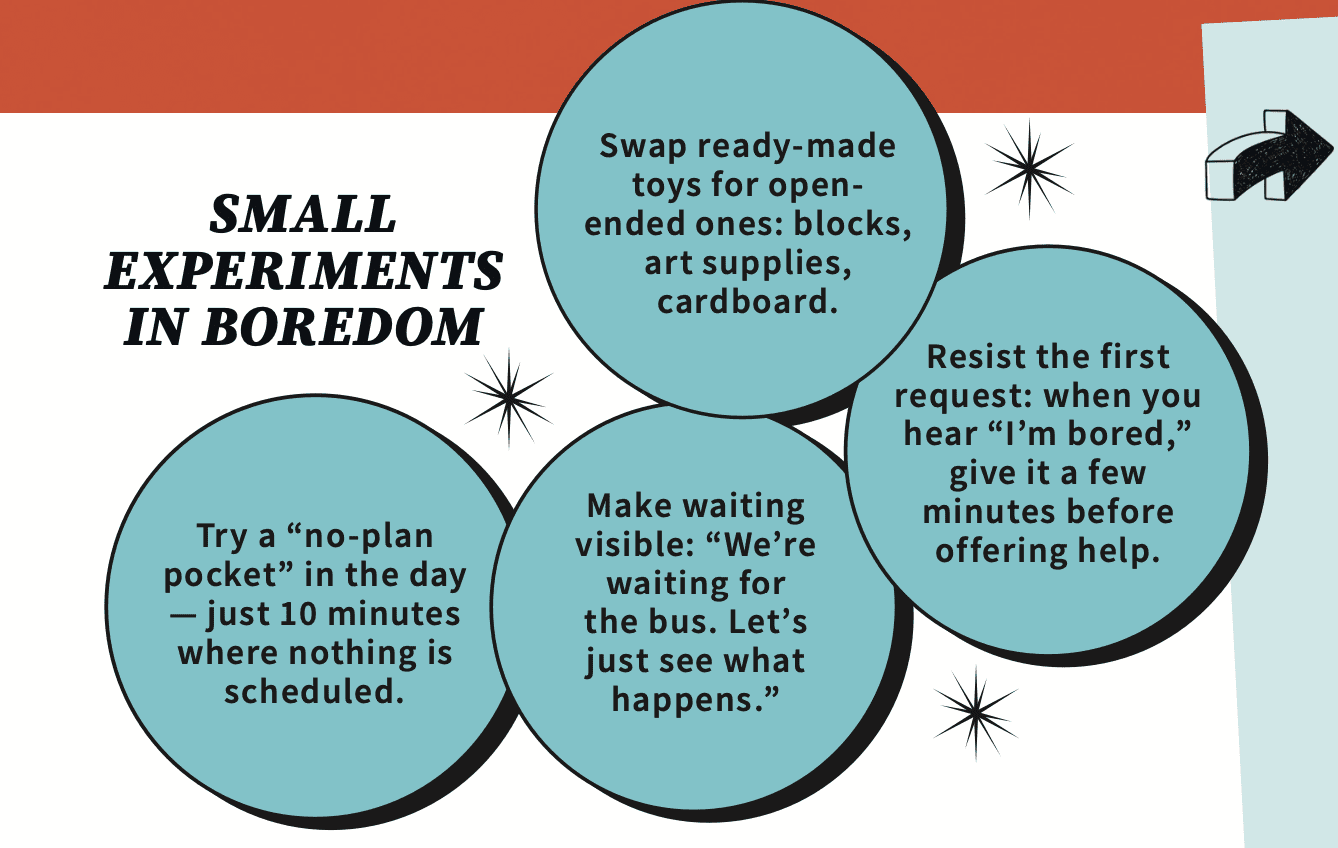
What to remember
Routines and screens aren’t the enemy. They’re essential supports – boredom is an addition, not a replacement.
Discomfort is normal. Boredom often starts with whining or frustration. That’s part of the process.
Start small. Even tiny doses of unstructured time help build tolerance.
Notice the wins. Point out what your child invents or discovers: “Look what you came up with!”
BOREDOM BREAKERS
Simple supplies, big possibilities. These aren’t activities to “keep kids busy” — they’re raw materials that spark imagination.
BUSY BOX
A shoebox with random bits: ribbons, plastic cups, cardboard tubes. Swap items every week for a fresh surprise.
ART GRAB-BAG
Washable paints, chunky chalk, masking tape, stickers, giant paper. Think big tools for big play.
SENSORY TRAY
A shallow box of rice, beans, or pasta with scoops and containers. Hide a few “treasures” inside for discovery.
BOX WORLD
Cardboard boxes, bubble wrap, egg cartons. Today a rocket, tomorrow a shop, the next day a drum kit.
NATURE BASKET
Pinecones, shells, smooth stones collected on a walk. Kids will sort, stack, or tell stories with them.
LOOSE PARTS
Buttons, beads, fabric scraps, scarves, wooden spoons. Open-ended objects that invite inventing.
DIY PUPPET THEATRE
A cereal box, some socks or paper bags, and pens. Let the kids run the show.
* PARENT TIP
Keep these in labelled baskets or crates. Sometimes just choosing a basket is the boredom-buster.