Caleb Rixon: not a victim – a survivor
Caleb Rixon of Genyus Network talks to Katherine Granich about story sharing, identity, and rebuilding life after stroke.
Caleb “Cal” Rixon is intentional about the words he uses. He’s a wordsmith with a background in acting, and his use of language is expressive and deliberate. Take, for example, his choice to describe himself as a stroke survivor rather than a victim. The distinction might seem small, but for Cal, it’s a powerful signal of his agency, and a comment on the way people are seen after life-changing medical events. Language, he believes, shapes how people understand themselves and how society understands them.
For Cal, language has been part of reclaiming his voice – both literally and metaphorically – after his own stroke at age 24. Today, Cal is Chief Vision Officer of Genyus Network (genyusnetwork.com), a growing social enterprise and community platform designed to empower and connect people living with acquired disability, trauma, and difference.
But Cal’s journey into this work began in circumstances he never could have imagined.
A life rewritten
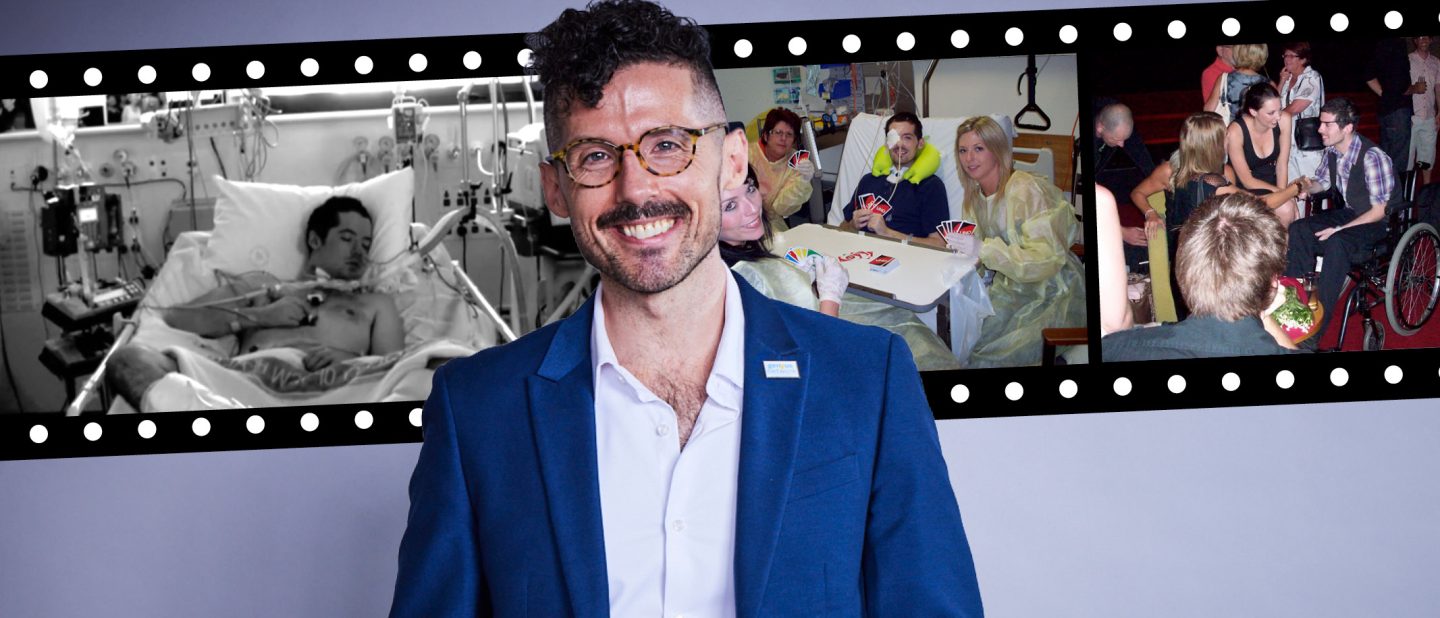
Before his stroke, Cal’s career in the performing arts was taking off. He had just secured a role touring nationally with the hit musical Chicago: The Musical when everything changed – he experienced a Grade 5 Subarachnoid Haemorrhage, the highest grading of the rarest form of stroke, due to a rare and undetected brain abnormality called Dural Arteriovenous Malformation (DAVM).
Cal spent over a month in the ICU, fully ventilated and in an induced coma, waking to discover he’d lost the ability to walk, talk, swallow, see, and breathe on his own.
Despite the severity of his condition, Cal remembers still trying to negotiate with his agent from his hospital bed, believing that he might simply delay joining the Chicago tour for a few months – not yet fully grasping the scale of his new reality.
Looking back, Cal describes this period as both devastating and transformative. He felt isolated and lost, but at the same time, recognised the opportunity to figure out what he wanted his life to be like post-stroke. “It was definitely a rebirth, and an opportunity to reframe what it is to have a voice,” he explains.
“At first I didn’t see myself as an activist – I just thought, ‘I’m a person rebuilding their life after catastrophic changes, and I’m trying to rewrite a new narrative.’ And I want other people to know that they can do that, too.
“The first chord of that is to find each other, find ourselves, feel connected, feel like we have purpose and worth.”
That reflection became the foundation for the work Cal does today.
The power of story sharing
Cal is reluctant to use the word “advocate”, instead describing himself as a “story sharer” focussed on centring mutual connection and empowerment: “My work is about illuminating bigger things, and helping people centre themselves in their own stories.
Genyus Network began in 2015 with Cal’s own feelings of loneliness, and subsequent search for connection with others who had experienced stroke or brain injury. What he discovered surprised him. When he started recording conversations with other stroke survivors, they were less interested in hearing his story and far more eager to share their own.
“I’m a performer. I’m the centre of my narrative; I’m the star of my story – and I realised that actually, everyone’s the lead role in their own story,” Cal says.
“So why don’t we give people tools and community to connect with as we write that new narrative, learn how to share that new narrative, and maybe reframe that new narrative?”

Today, Genyus Network creates structured spaces where people with lived experience can connect socially, share experiences, and build their confidence. It’s peer-led, by survivors and for survivors, with a Board of Directors filled with talented professionals who have lived experience of disability.
Genyus provides support and leadership programs that promote confidence, improve self-esteem and communication skills, enrich rehab outcomes, and enhance overall capacity for people to participate and contribute, both personally and professionally, to community life.
Not just a list of symptoms
One of Cal’s strongest messages is the need to shift how disability is viewed. He believes disability is too often framed through a purely clinical lens, reducing individuals to lists of symptoms, diagnoses, or service requirements.
Instead, he advocates for a social and human-centred perspective that prioritises identity, relationships, and belonging.
With 700,000 people in Australia living with a brain injury, it’s not a small cohort, but loneliness and isolation is rarely addressed by clinical services (or, indeed, even mentioned as an issue – despite the staggering statistics around self-harm and suicide among people with mental and physical health issues). As the Genyus website states: “96% of young stroke survivors often lack access to follow-up therapy and support to resume everyday life.”
That 96% is who Genyus Network strives to reach – with a caveat. “It’s not a support group. Support is a byproduct of the badass connections that happen in this community platform,” Cal says emphatically. “It’s not about having ‘misery meetups’ where disabled people sit around feeling sad. It’s about sharing, connecting, celebrating – giving people a safe space to find others who understand.”
And the community has grown far beyond Australia. Now with a worldwide community of stroke and ABI survivors (plus supporters) from more than 50 countries, it’s a social enterprise that’s reaching beyond borders, connecting people from all walks of life.
Looking forward
Cal is currently taking part in a Wespac Social Change Fellowship, as one of 10 remarkable Australians tackling some of the country’s most pressing social challenges. It’s an opportunity for self-reflection and professional development, and Cal thinks deeply about his role as a social change leader – one he never imagined for himself, but feels privileged to hold.
“Over the years I’ve learned just how powerful my story is, as a vehicle for connection and awareness. I love sharing my story, and utilising it for good – to be in service of bigger things.”
Genyus continues to expand, with plans for global collaboration and new initiatives. Cal is particularly passionate about developing spaces that use gamification, social engagement, and peer connection to build confidence and wellbeing. And while Genyus Network is currently aimed at adults – “Genyus” stands for “Gen Y United Survivor” – he doesn’t rule out a Genyus Junior version of the platform in the future, helping kids and teens navigate acquired disability and trauma.
Despite the organisation’s growth, Cal remains grounded in his original mission: Helping people connect and rediscover identity, purpose, and belonging after life changes that can feel isolating or overwhelming.
“I believe in getting to the story beyond the symptoms,” he says. “People are not just a collection of symptoms – they’re humans. And human stories have value.”
Learn more about Caleb and his work at calebrixon.com and genyusnetwork.com